Smart Casual: Complete Outfit Ideas, Dress Code and Styling Guide (2026)
You get the invite, the interview confirmation or the office memo and there it is: “dress code smart casual” No further explanation.
You open your closet and stare at two extremes: a suit that feels like overkill and a t-shirt that feels like underdressing with nothing that obviously fits in between. That gap is exactly why “smart casual” is one of the most searched dress codes in the world. It doesn’t have a single fixed rulebook.
It shifts depending on the event, the industry and even the country you’re in, which is what makes it so easy to get wrong in either direction, too stiff or too relaxed. This guide clears that up.
You’ll learn exactly what smart casual means, how it compares to business casual and plain casual, what to wear as a man or a woman, how to adjust it by occasion and which “borderline” items jeans, sneakers, polos actually work and which don’t.
Quick Answer
Smart casual is a dress code that blends polished, put-together pieces with relaxed, comfortable ones.
It sits between casual and business casual: think a blazer with dark jeans, tailored trousers with a knit sweater or a collared shirt with chinos. Skip formal suits, sneakers, hoodies and flip-flops.
What Does Smart Casual Mean?
Smart casual means dressing in a way that looks deliberate and put-together without being formal.
The idea is to pair at least one “smart” (polished, structured) piece with at least one “casual” (relaxed, comfortable) piece, so the outfit reads as intentional rather than sloppy or overdressed.
In practice, that usually means combining items like:
- A blazer or structured jacket with jeans or chinos
- A collared shirt or blouse with tailored trousers
- A knit sweater with dress pants
- Clean, polished shoes instead of trainers or sandals
The term has been used in menswear since roughly the 1950s to describe a suit that was more relaxed than office wear but smart casual as most people recognize it today took shape in the 1980s, when informal workplace attire started blurring the line between work clothes and everyday clothes.
That history explains why the dress code still lives in a gray area: it was built to be flexible from the start, not standardized. Because there’s no single governing rulebook, the exact expectations for smart casual can vary by company, region and event type.
The constant across all of them is the goal, not the specific pieces: look neat, considered and appropriate for the setting, not sloppy and not overdressed.
Where Smart Casual Fits on the Formality Spectrum
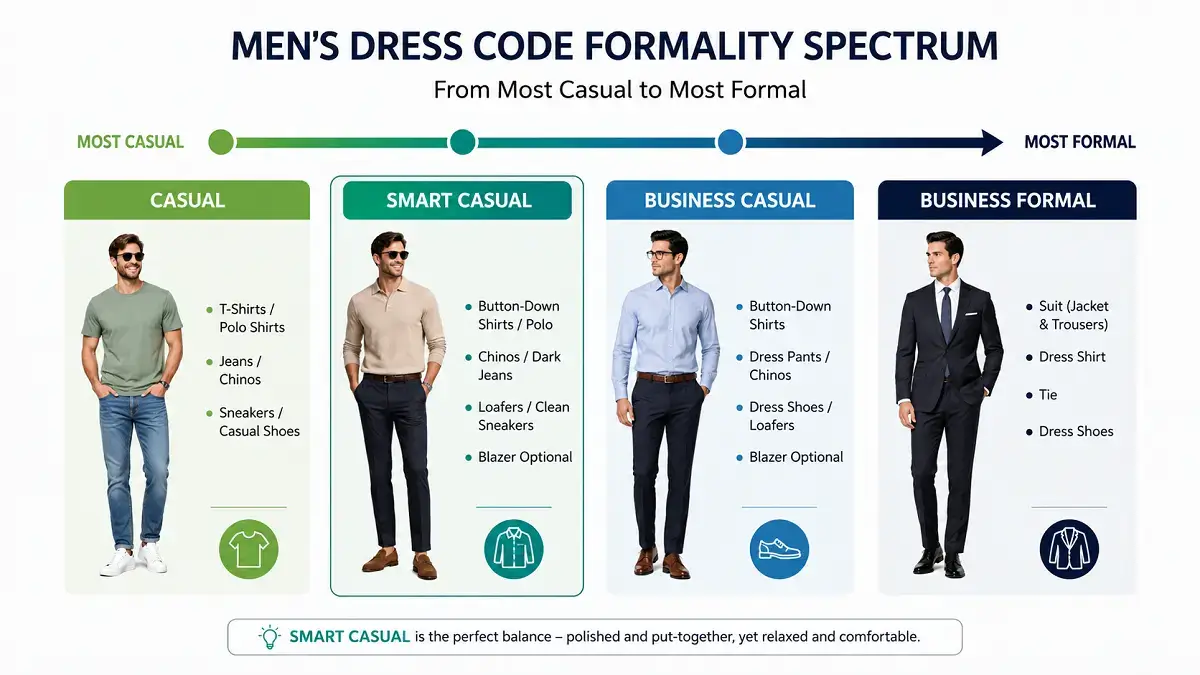
The easiest way to understand smart casual is to see it next to the dress codes around it.
Most style authorities place it in this order, from least to most formal:
Casual → Smart Casual → Business Casual → Business Formal
- Casual is your everyday clothing jeans, t-shirts, sneakers with no expectation of polish.
- Smart casual takes that same relaxed foundation and adds one or two elevated pieces, like a blazer or dress shoes, to look intentional.
- Business casual is a step more formal and more structured, think dress pants, a button-down shirt and closed-toe shoes, with jeans and sneakers generally off the table.
- Business formal (suit and tie or an equivalent formal outfit) sits at the top.
This ordering is the convention followed by most style guides but it isn’t universal. A minority of sources treat “smart casual” and “business casual” as closer to interchangeable or even use smart casual to describe a slightly more polished, trend-forward version of business casual rather than a less formal one.
If you’re dressing for a specific employer or event, the safest move is to check with the host, HR or venue when the dress code isn’t explained further. The label alone doesn’t guarantee everyone means exactly the same thing by it.
Smart Casual vs Business Casual vs Casual
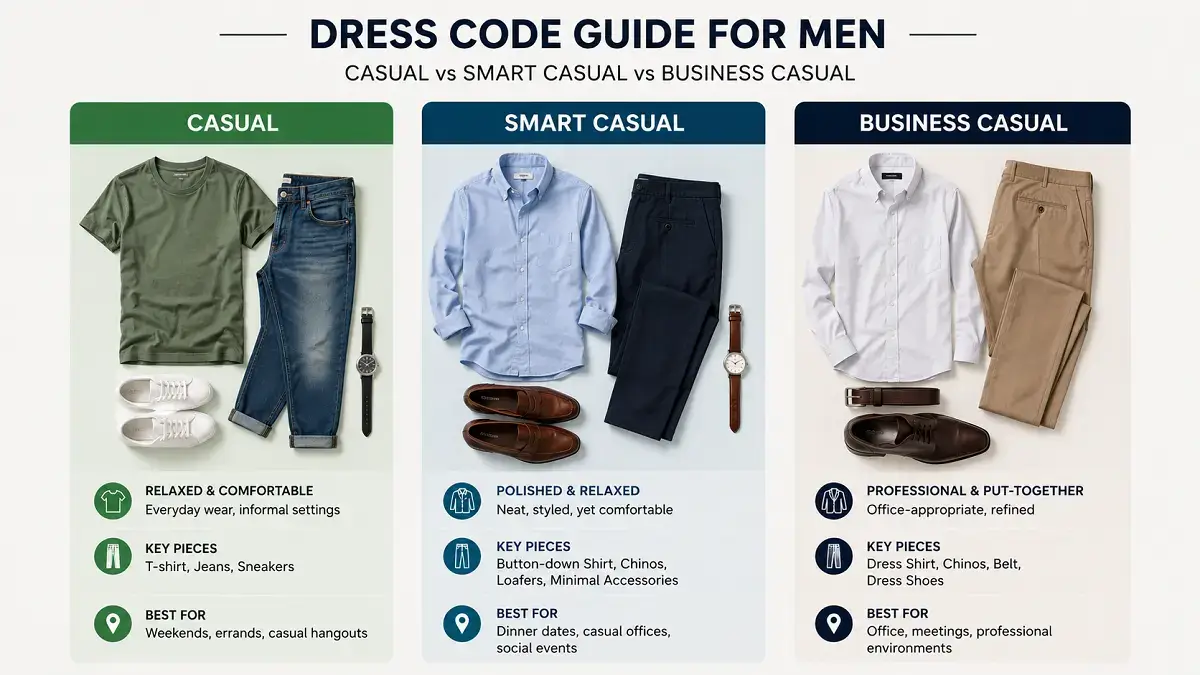
Here’s how the three dress codes compare directly, so you can see where the lines are drawn.
| Element | Casual | Smart Casual | Business Casual |
|---|---|---|---|
| Tops | T-shirts, tanks | Polo, collared shirt, fine-knit sweater, blazer optional | Button-down shirt, blouse, blazer common |
| Bottoms | Jeans, shorts | Dark, well-fitted jeans or chinos, tailored trousers | Dress pants, chinos, tailored skirt |
| Shoes | Sneakers, sandals, flip-flops | Loafers, clean leather sneakers, ankle boots, low heels | Oxfords, loafers, closed-toe flats or heels |
| Outerwear | Hoodie, casual jacket | Blazer, structured jacket, trench coat | Blazer, sport coat |
| Typical use case | Weekend errands, home | After-work socials, dinners, creative offices, some interviews | Traditional office, client meetings |
The practical difference comes down to structure and intention. Business casual is built around traditional workwear with the stiffness dialed down.
Smart casual starts from a relaxed base and adds just enough polish, a blazer, tailored trousers, real shoes to look considered rather than thrown together. Casual has no such requirement either way.
A simple way to remember it: business casual dresses down from a suit; smart casual dresses up from your everyday clothes. Both can land in a similar-looking outfit but they start from opposite ends of the closet.
Smart Casual for Men
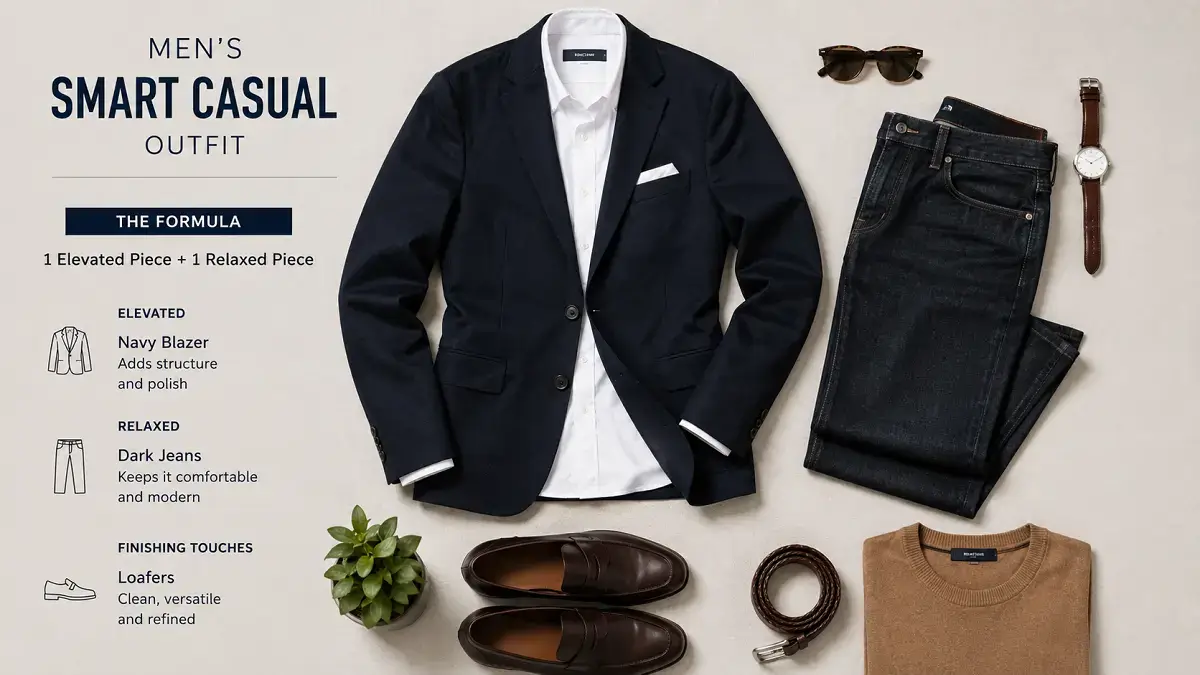
For men, smart casual means pairing one relaxed piece with one elevated piece rather than going fully formal or fully casual on every item at once.
Tops
- Collared button-down shirts (solid or subtly patterned)
- Polo shirts in a quality knit, no large graphics
- Fine-knit sweaters or crewnecks, worn alone or layered under a blazer
- A plain crewneck or v-neck t-shirt can work under a blazer in more relaxed smart casual settings but skip anything with a graphic or slogan
Bottoms
- Chinos or tailored dress trousers
- Dark-wash, distress-free jeans in a slim or straight fit
- Avoid shorts, sweatpants or joggers regardless of fabric quality
Shoes and Accessories
- Loafers, Oxfords or Derby shoes in leather for the dressiest looks
- Clean, minimal leather sneakers or Chelsea boots for a more relaxed take
- A leather belt that matches your shoes, a simple watch and a pocket square for evening events
- Avoid running shoes, sport sandals and anything visibly worn or scuffed
Two Outfit Formulas to Copy
- Office-to-evening: Navy blazer, light blue button-down (tucked), khaki chinos, brown loafers.
- Relaxed weekend smart casual: Fine-knit crewneck sweater in navy or grey, dark straight-leg jeans, clean white leather sneakers.
Smart Casual for Women
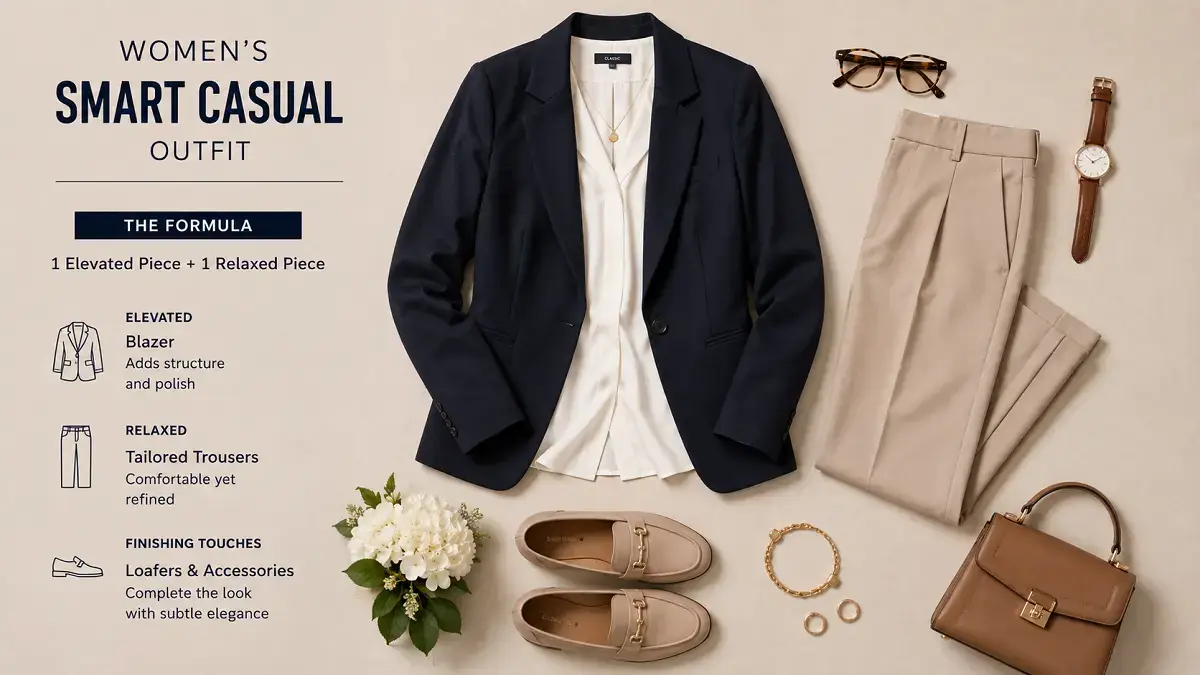
For women, smart casual works the same way: mix a polished piece with a relaxed one but with more room to use dresses, skirts and color as the “smart” element instead of always relying on a blazer.
Tops and Dresses
- Blouses in structured or interesting fabrics, collared shirts or button-ups
- A well-fitted blazer worn over a simple top instantly elevates the outfit
- Sheath dresses or collared shirt dresses for one-piece outfits
- Avoid plain cotton t-shirts, large graphic prints or anything overly revealing (cutouts, sheer fabric, tank tops without a layer)
Bottoms
- Tailored trousers, wide-leg pants or chinos
- Pencil or A-line skirts in solid, non-formal fabrics (skip pinstripes, which read as business casual)
- Dark-wash, tailored, distress-free jeans
Shoes and Accessories
- Loafers, pointed-toe flats or low-to-mid block heels
- Ankle boots or clean leather sneakers for a more relaxed version
- One or two simple accessories delicate jewelry, a structured bag, a watch rather than a full statement set
- Avoid athletic sneakers, flip-flops and floor-length dresses, which tend to read as either too casual or too formal for this dress code
Two Outfit Formulas to Copy
- Classic office smart casual: Tailored blazer, silk or cotton blouse, wide-leg trousers, pointed-toe flats.
- Dinner or social smart casual: Wrap dress or midi skirt with a fitted knit top, ankle boots or block heels, a structured tote or clutch.
Smart Casual by Occasion
Smart casual flexes depending on where you’re wearing it.
Here’s how to adjust for the most common situations.
| Occasion | Aim For | Skip |
|---|---|---|
| Office / everyday work | Chinos or trousers, collared shirt or blouse, loafers or clean flats | Jeans with holes, sneakers with logos, hoodies |
| Job interview | The more polished end of smart casual blazer, tailored trousers, closed-toe shoes | Anything overly casual; when unsure, lean more formal than the job posting suggests |
| Wedding guest | Dress and heels or trousers with a blazer and dress shirt, in season-appropriate colors | White or very light colors (reserved for the couple), overly casual denim |
| Dinner or date night | A slightly dressier version silk top or knit sweater with tailored pants or a fitted dress | Athletic wear, flip-flops, anything that needs constant adjusting |
| Networking event / conference | Blazer as the anchor piece, paired with dark jeans or trousers | Full formal suit (can read as overdressed for a casual mixer) |
| Summer | Lightweight fabrics linen shirts, midi skirts, tailored shorts in some settings, loafers without socks | Heavy fabrics, closed formal suits |
| Winter | Fine-knit sweaters, tailored trousers, ankle boots, a structured coat or blazer layered over everything | Bulky puffer jackets as the outermost layer for indoor events |
When an invite or workplace doesn’t clarify further, match the formality of the people likely to be around you err slightly more polished for a first impression (interviews, new clients) and slightly more relaxed for purely social events.
Borderline Pieces: Jeans, Sneakers, Polos and More
Certain items sit right on the edge of smart casual and they’re the ones people ask about most.
Common Smart Casual Mistakes to Avoid
- Going fully formal: A full suit and tie or a floor-length formal gown, overshoots smart casual and can look out of place, even at events labeled “smart casual” alongside more formal ones.
- Going fully casual: Showing up in jeans and a plain t-shirt with no elevated piece misses the “smart” half of the dress code entirely.
- Wearing worn-out or wrinkled clothing: Smart casual is about looking deliberate. Scuffed shoes, visible wrinkles or stretched-out fabric undercut even a well-chosen outfit.
- Over-accessorizing: Piling on statement jewelry, bold prints and multiple bright colors at once can push a smart casual look into “too busy” instead of “polished.”
- Ignoring the specific event: The same outfit that works for a Friday office day might be too relaxed for a client dinner or too dressy for a casual backyard gathering. Read the event, not just the dress code label.
- Assuming the term means the same thing everywhere: Smart casual expectations shift by company culture, industry, climate and country. What’s acceptable in one workplace or region can look underdressed or overdressed in another.
Quick Smart Casual Checklist
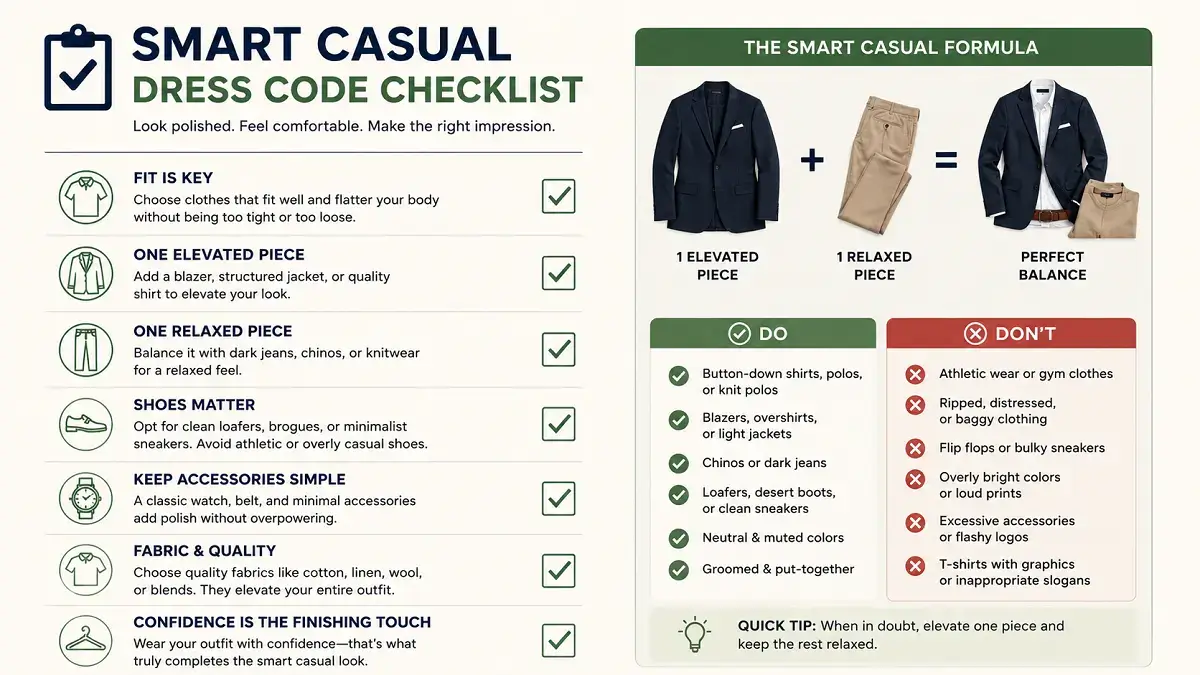
Before you head out the door, run through this:
- At least one “elevated” piece (blazer, blouse, tailored trousers or dress shoes)
- At least one “relaxed” piece (jeans, knitwear or a simple top)
- Shoes are clean, closed-toe (or a polished sandal/flat for warm weather) and not athletic
- Clothing is wrinkle-free, well-fitted and free of visible wear or damage
- No more than one or two accessories, kept simple
- Nothing from the “never wear” list: hoodies, sweatpants, flip-flops, athletic wear, ripped clothing
- Outfit matches the specific occasion, not just the dress code label
Frequently Asked Questions
Conclusion
Smart casual isn’t about memorizing a fixed list of approved items, it’s about pairing one polished piece with one relaxed piece so the outfit looks intentional rather than thrown together or overdressed.
Start from that principle, adjust for the specific occasion and skip the pieces that read as too formal (full suits, floor-length gowns) or too casual (hoodies, athletic wear, flip-flops) on either end.
Once you’ve built a few go-to smart casual outfits, one office-ready, one for evenings and social events, dressing for that “smart casual” invite stops being a guessing game.
If you’re building out your wardrobe further, our guides on business casual dress codes and how to style a blazer multiple ways are natural next steps.