Jilbab vs Abaya: What’s the Difference? (Plus Hijab, Niqab and Burka Explained)
Introduction
If you’ve come across the words jilbab, abaya, hijab, niqab and burka used almost interchangeably online, you’re not alone in finding it confusing. These terms all describe modest Islamic clothing but they are not the same garment and mixing them up can lead to real misunderstandings whether you’re researching modest fashion, learning about Islamic dress codes or simply trying to use the right word.
The confusion usually comes down to one thing: each term describes a different part of a modest outfit or a different level of coverage. A jilbab and an abaya are both outer garments but they’re cut differently and serve slightly different purposes. A hijab is a headscarf, not a body covering. A niqab and a burka both cover the face but in different ways.
This guide breaks each garment down individually, then compares them head-to-head jilbab vs abaya, hijab vs abaya, hijab vs jilbab and the full five-way comparison including niqab and burka so you finish with a clear, accurate picture of what each term actually means.
Quick Answer
A jilbab is a loose, long outer garment that covers the whole body, often including a built-in head covering. An abaya is a similar loose outer robe, usually open at the front and worn without an attached headscarf, paired instead with a separate hijab. Both promote Islamic modesty but the jilbab is more of an all in one covering, while the abaya is typically layered with other pieces.
What Is a Jilbab?
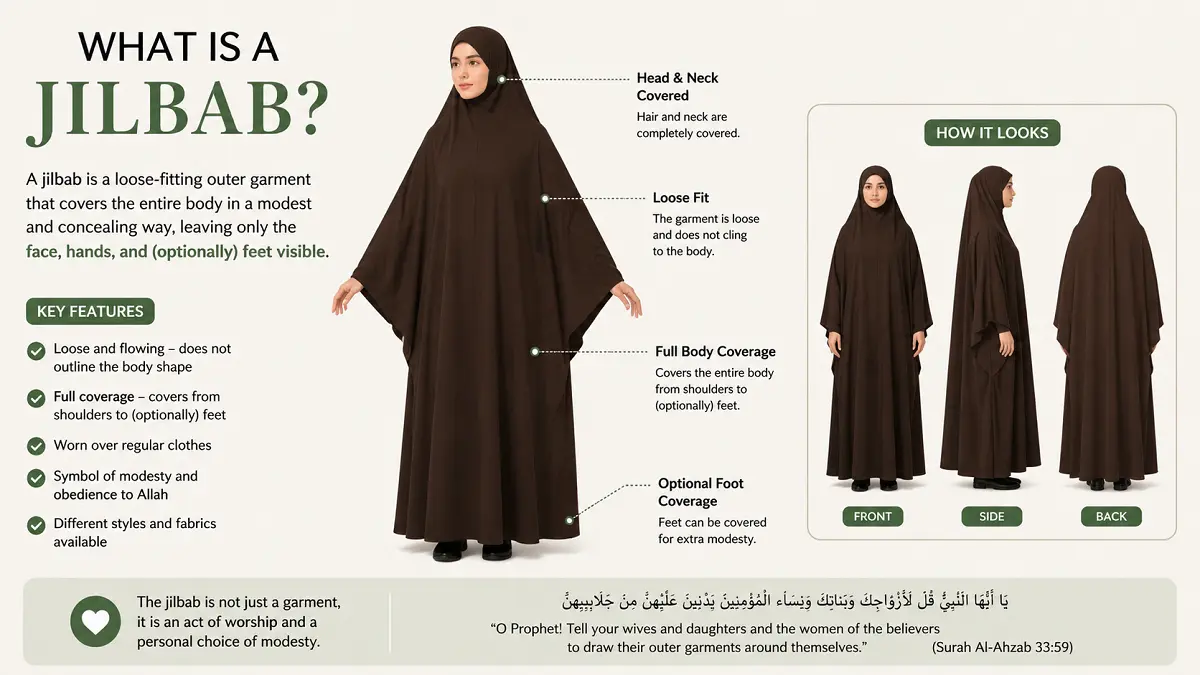
A jilbab (also spelled jilbaab or jilbab, from the Arabic جِلْبَاب) is a long, loose-fitting outer garment worn by Muslim women over their regular clothing. The term refers broadly to any long, loose coat or outer garment that covers the entire body except the face and hands and wearers understand this style of dress to fulfill the Quranic instruction for hijab (modest covering).
In some regions, the jilbab includes an attached head covering, meaning it can function as a single, all in one modest outfit rather than several separate pieces.
Because a jilbab is defined by its function full-body coverage in a loose, non-revealing shape rather than by one fixed style, its appearance varies significantly by region. In some cultures it’s worn as a long coat, sometimes called a Turkish style jilbab, cut generously so the wearer can move freely without restriction. Fabrics range from lightweight cottons in warmer climates to heavier wool or polyester blends in colder regions.
Jilbab in Islam
The jilbab has a specific religious basis. The Arabic word appears in the Quran at Surah Al-Ahzab, verse 33:59 and this verse underlies various Islamic conventions around women’s dress. Islamic scholarship generally treats the jilbab not as one specific cut of clothing but as a category of garment that must meet certain conditions chiefly, that it is loose enough not to outline the body’s shape and opaque enough not to be see through. Under this view, a milhafah (wrap), an abaya (cloak) or a mula’ah (loose wrap around) can all qualify as a jilbab, provided they cover the whole body and meet the required standards of modest dress.
This is an important nuance: in classical Islamic usage, “jilbab” is closer to a concept (an adequately modest outer covering) than a single named product which is part of why it’s so often confused with or used to describe an abaya.
Definition of Jilbab
Stripped of religious and regional context, the plain-language definition is straightforward. A jilbab is a long piece of clothing worn by some Muslim women, worn over other clothes, that covers the whole body and sometimes the head as well. Dictionary sources similarly describe it as a long robe covering the head, worn by some Muslim women a definition that captures the two features that distinguish a jilbab from many other outer garments: full-body length and, frequently, an integrated head covering.
What Is an Abaya?
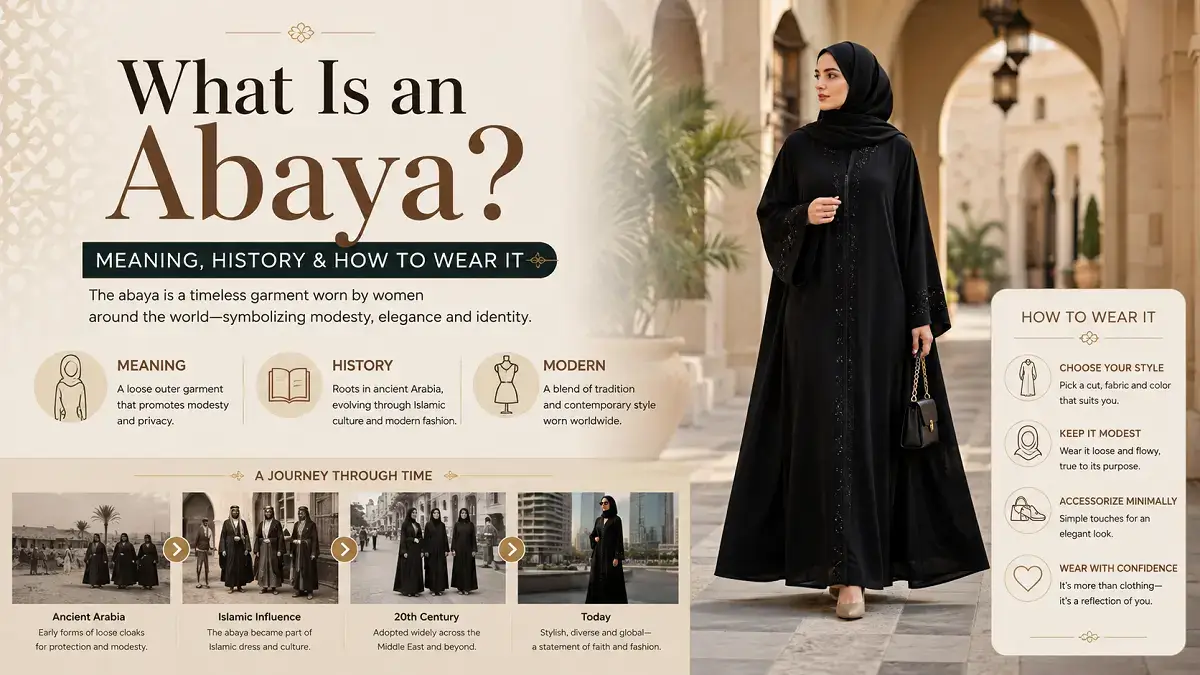
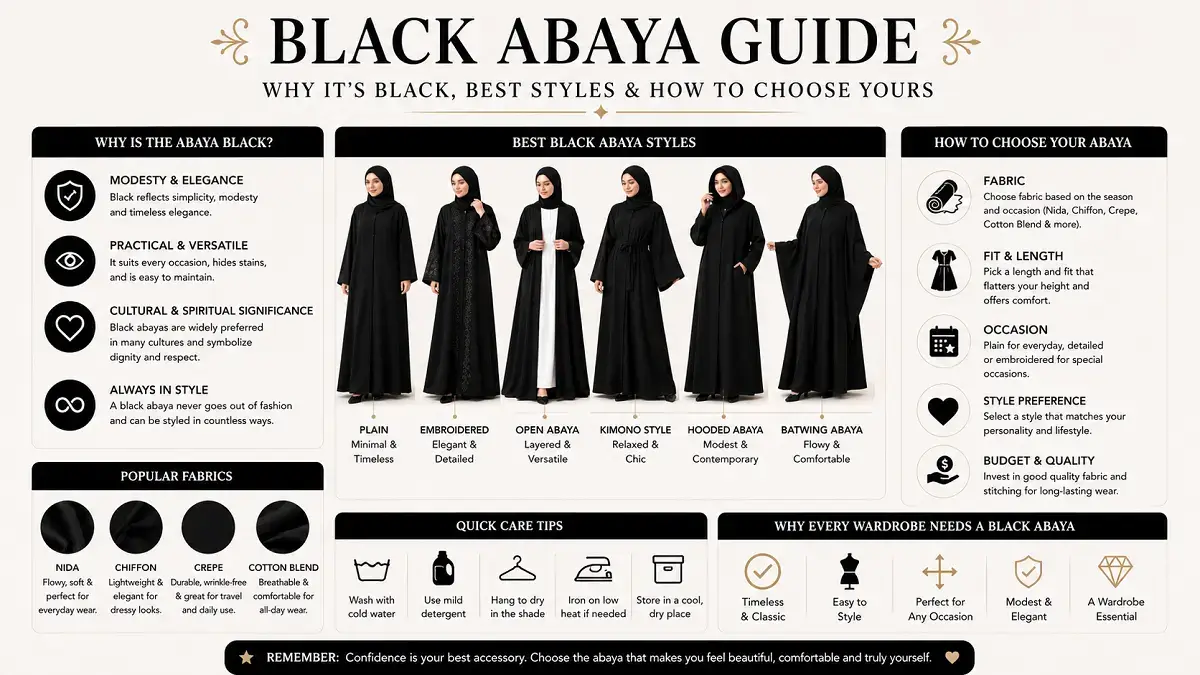
An abaya is a long, flowing outer robe traditionally worn over regular clothing, most closely associated with the Gulf region (Saudi Arabia, the UAE and neighboring countries), though it is now worn and sold worldwide as part of modest fashion. Traditionally black, the modern abaya comes in a wide range of colors, fabrics and embellishments, from simple crepe designs to more elaborate embroidered or beaded styles.
The key structural feature of an abaya is that it typically does not include a built-in head covering. It’s designed to be layered with a separate hijab or headscarf to complete a modest outfit and it’s commonly open at the front, closed with snaps buttons or a simple wrap-and-tie style, though closed-front designs also exist.
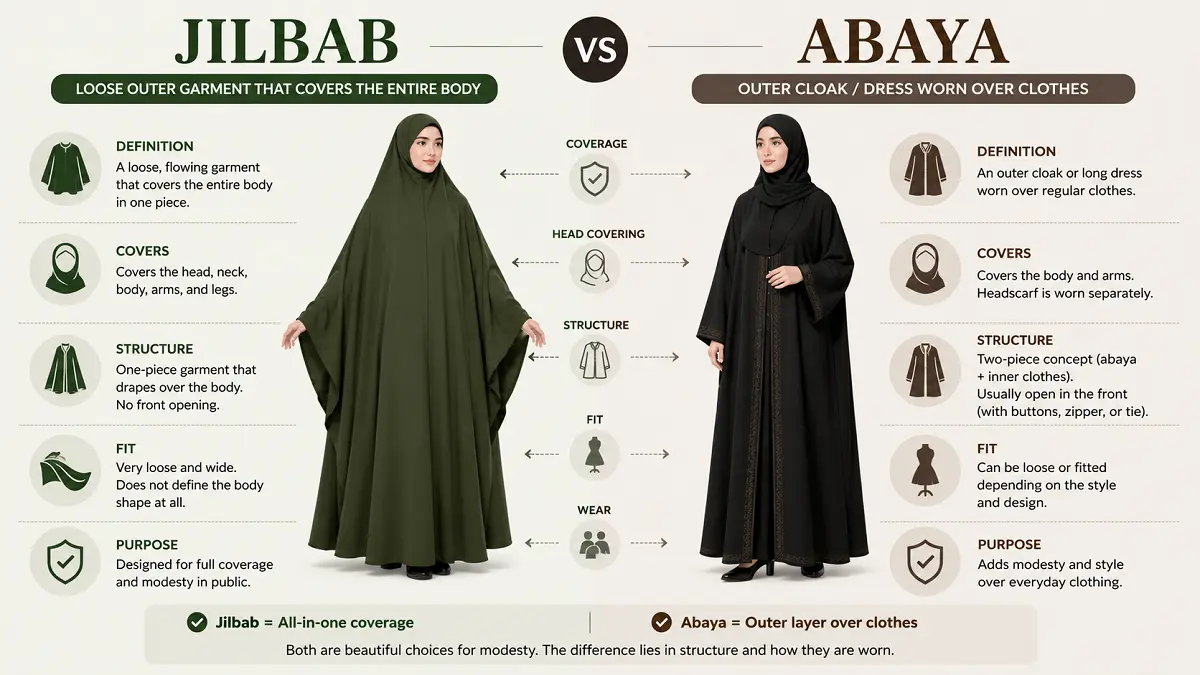
Jilbab vs Abaya: Key Differences
While both garments serve the same underlying purpose full-body modest coverage they differ in construction origin and how they’re typically worn.
| Feature | Jilbab | Abaya |
|---|---|---|
| Head covering | Often built in or attached | Usually separate; worn with a hijab |
| Front closure | Frequently closed/coat-style | Frequently open-front or wrap style |
| Structure | More coat-like; sometimes more tailored | Loose, flowing robe |
| Common region | Southeast Asia, parts of the Levant | Gulf region (Saudi Arabia, UAE) |
| Worn by | Primarily women; historically also used for men’s outer garments in some contexts | Primarily women |
| Styling | Fewer separate pieces needed | Often paired with accessories: separate hijab, belt |
In everyday conversation, many people use “jilbab” and “abaya” interchangeably and in some communities the terms genuinely do overlap; a garment marketed as a “jilbab” in one country might look identical to what’s sold as an “abaya” in another. The most reliable distinction to hold onto is this: a jilbab is more likely to be an all-in-one covering with a head piece attached, while an abaya is more likely to require a separate hijab.
What Is a Hijab?
Unlike a jilbab or abaya, a hijab is not a full-body garment, it’s a headscarf. The word hijab comes from an Arabic root meaning “barrier” or “cover,” and while it’s used broadly in Islamic teaching to describe the overall concept of modest dress, in everyday usage it specifically refers to the cloth worn to cover the hair, neck and sometimes shoulders, while leaving the face fully visible.
Because a hijab only covers the head, it’s not a substitute for a jilbab or abaya, it’s a complementary piece. Someone wearing an abaya, for instance, typically pairs it with a hijab to complete a modest outfit, since the abaya itself usually doesn’t cover the hair.
Hijab vs Abaya
The hijab vs abaya comparison is really a comparison of scope, not competing alternatives; the two are usually worn together rather than instead of one another.
- Hijab: Covers the hair, neck and sometimes the shoulders. Leaves the face visible. Available in many colors, fabrics and styles and can be worn with any outfit, not just modest robes.
- Abaya: Covers the body from the shoulders to the feet. Does not cover the hair on its own.
A woman can wear a hijab without an abaya (paired with regular modest clothing) but an abaya is most commonly worn with a hijab to achieve full modest coverage, since the abaya alone leaves the hair exposed.
Hijab vs Jilbab
Because some jilbab styles include an attached head covering, the hijab-vs-jilbab comparison sometimes causes more confusion than hijab-vs-abaya. The core distinction, though, is the same principle: a hijab is a head-covering piece, while a jilbab is a full-body garment that may or may not include a head covering as part of its design.
If a jilbab has an integrated hood or headscarf, it can function as a complete outfit without needing a separate hijab. If it doesn’t, it’s typically worn with one, the same way an abaya is.
What Are the Niqab and Burka?
Two related terms niqab and burka extend the modesty concept to the face and they’re frequently confused with each other.
What Is a Niqab?
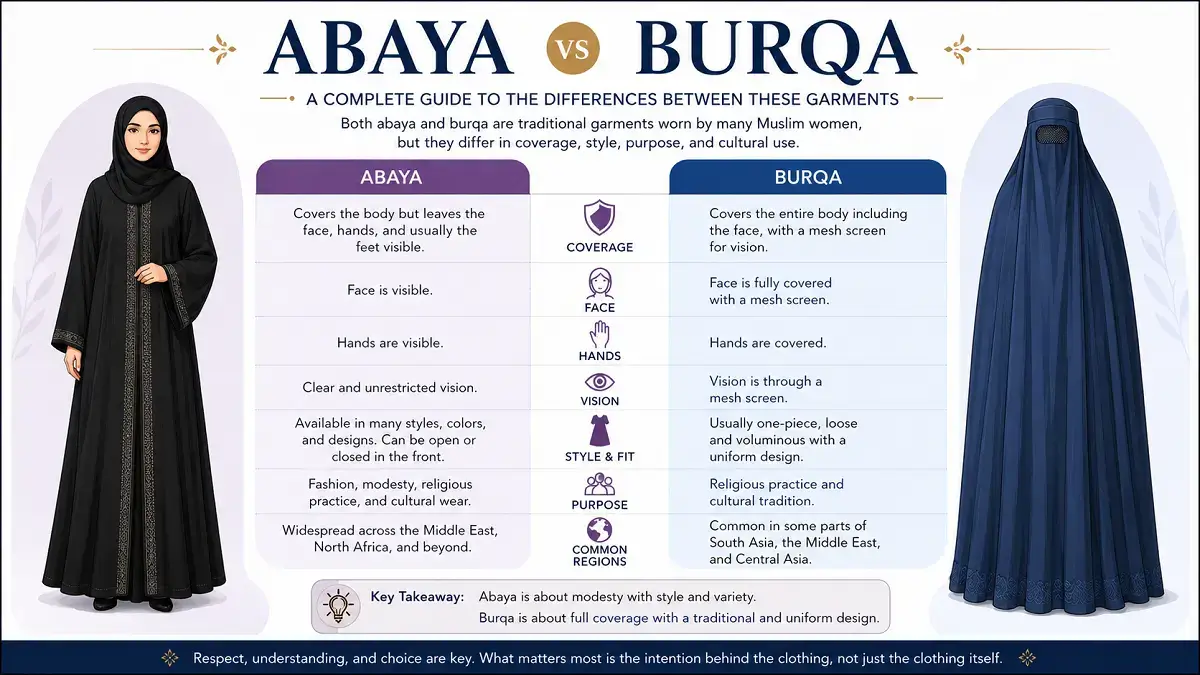
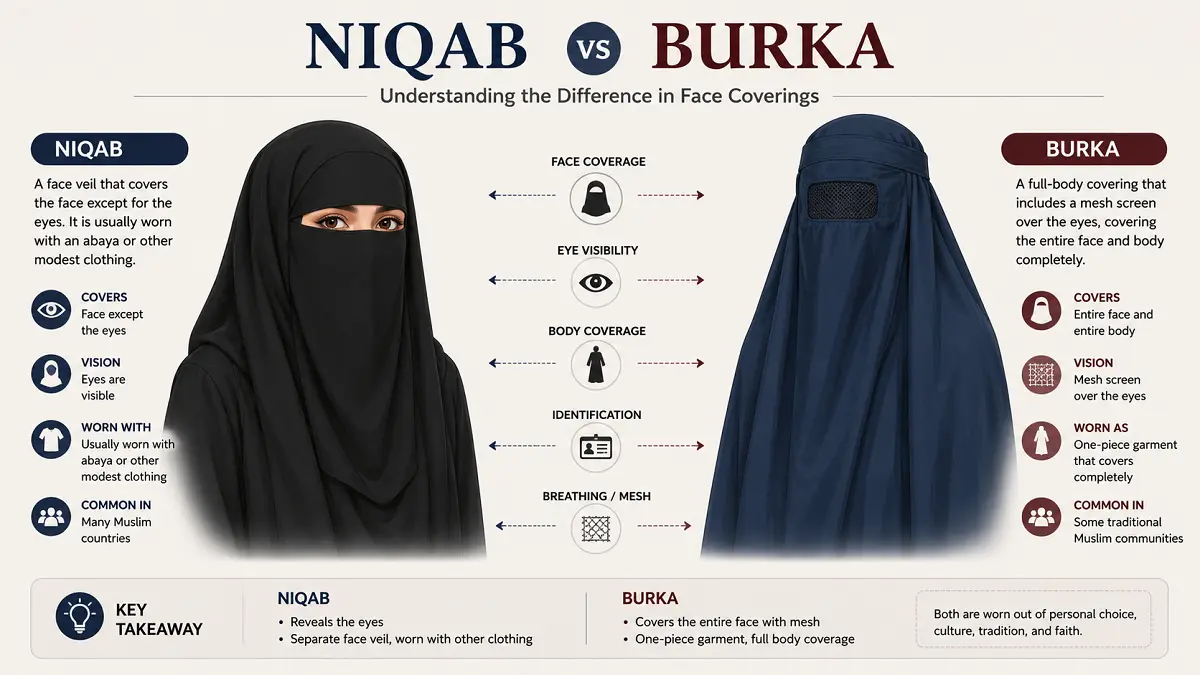
A niqab is a face veil, typically worn together with a headscarf and a loose outer garment such as an abaya. It covers the face while leaving the eyes open and it’s assembled from separate pieces: a headscarf, an outer garment and the face veil itself rather than being one single piece of clothing. Some styles cover down to the chin, while others leave slightly more of the upper face visible.
What Is a Burka?
A burka (also spelled burqa) is the most concealing of the group. It covers the entire body and face, including the eyes, typically through a mesh panel that lets the wearer see while remaining fully covered. Unlike a niqab, which is built from several separate pieces layered together, a burka is usually a single, one-piece garment worn on its own.
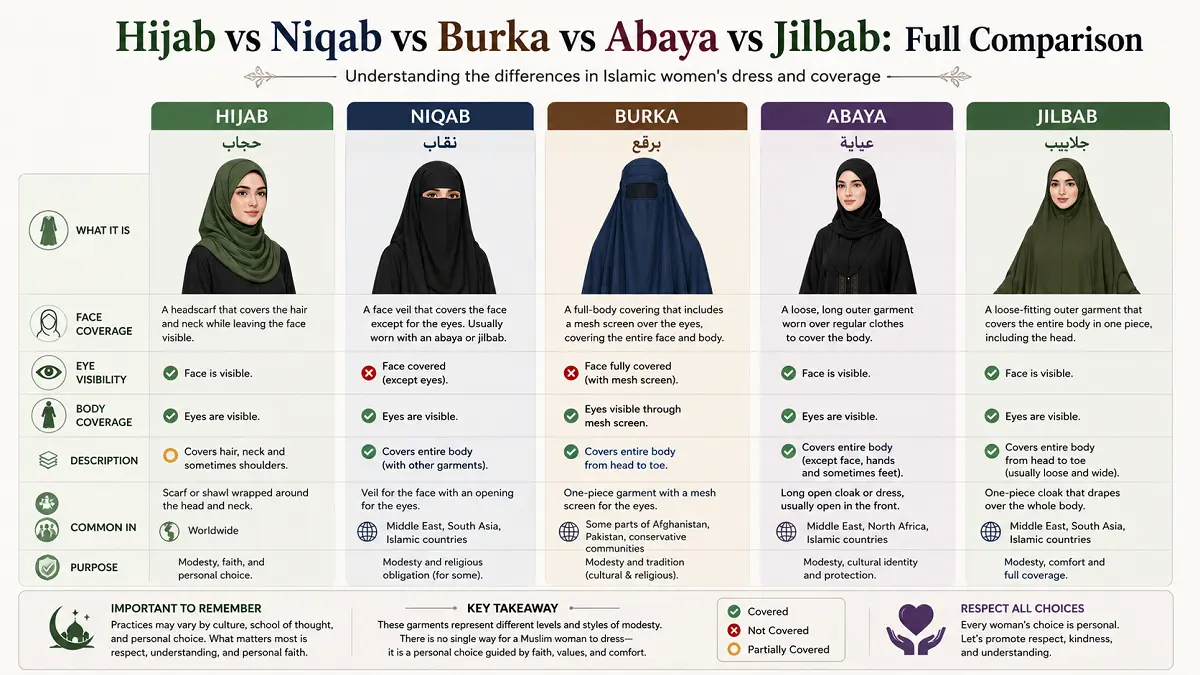
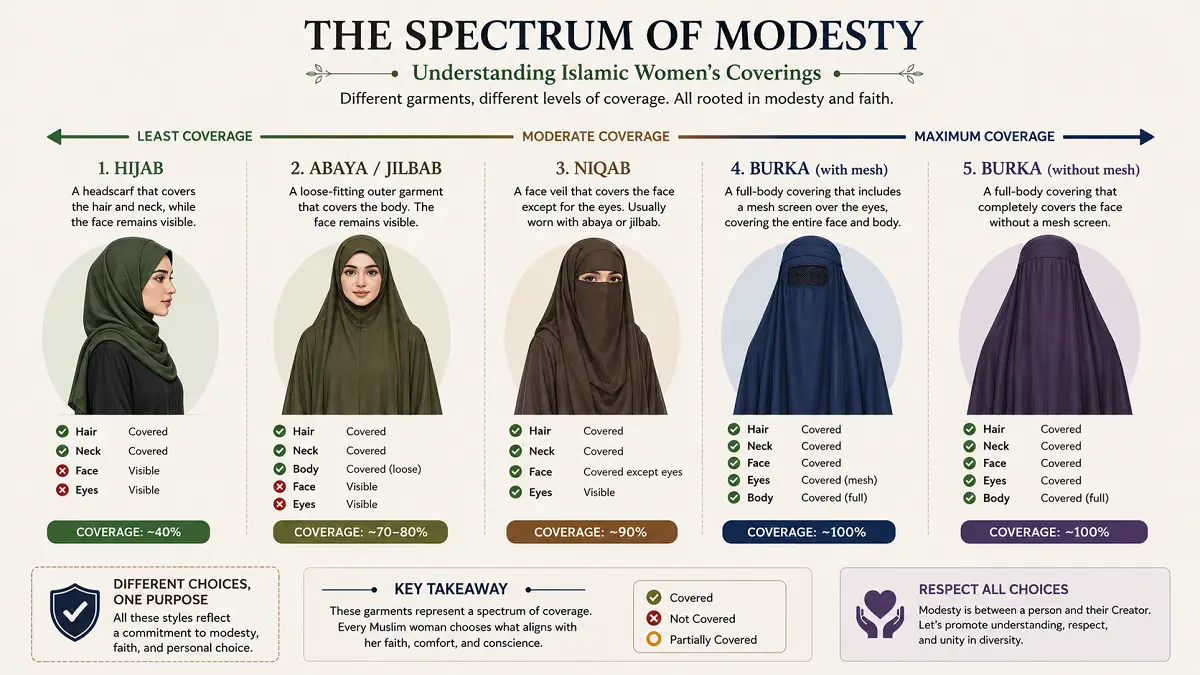
Hijab vs Niqab vs Burka vs Abaya vs Jilbab: Full Comparison
Put together, these five terms form a spectrum of coverage rather than five unrelated categories. The table below summarizes how each one fits, regardless of which order you search them in (hijab vs burka vs niqab vs abaya, hijab vs abaya vs burka, burka vs hijab and abaya and so on all point to this same comparison):
| Garment | Covers | Face Visible? | Worn Alone or Layered? |
|---|---|---|---|
| Hijab | Hair, neck, sometimes shoulders | Yes, fully | Layered with regular or modest clothing |
| Abaya | Body (shoulders to feet) | Yes, fully | Usually layered with a separate hijab |
| Jilbab | Body, often including head | Yes, fully | Can be worn alone if it includes a head covering |
| Niqab | Face (except eyes) | Only eyes | Layered over a headscarf and outer garment |
| Burka | Entire body and face | No (mesh panel over eyes) | Worn alone as a single piece |
Reading the table left to right roughly tracks increasing coverage: a hijab covers the least (head only), an abaya and jilbab add full-body coverage and a niqab or burka add face coverage on top of that. None of these garments are mutually exclusive substitutes for one another in the way, say, two competing brands of the same product would be most are designed to be combined.
How to Tell Which Garment Someone Is Describing
Because usage varies by country, community and even individual family tradition, the fastest way to identify which garment is being discussed is to ask two questions:
- Does it cover the face? If yes, it’s a niqab or burka. If the eyes are also covered by mesh, it’s a burka; if the eyes remain visible, it’s a niqab.
- Does it cover the hair but not the body? If yes, it’s a hijab. If it covers the full body (with or without the head), it’s a jilbab or abaya and whether it includes a built-in head covering is usually the clearest way to distinguish between those two.
Common Mistakes and Misconceptions
- Treating all five terms as synonyms. They describe different pieces of an outfit, not five names for the same thing.
- Assuming every Muslim woman wears all five. Coverage choices vary widely based on personal belief, culture and country. Many women wear a hijab alone, others an abaya and hijab and face-covering styles like the niqab and burka are worn by a smaller subset for additional modesty.
- Confusing niqab and burka. The quickest distinction: a niqab leaves the eyes visible; a burka covers them with a mesh panel.
- Assuming “jilbab” means one specific cut of clothing. As Islamic scholarship on the term makes clear, it functions more as a category any garment that meets the modesty conditions (loose, non-transparent, full coverage) can be considered a jilbab, which is why its appearance differs so much across regions.
Frequently Asked Questions
Conclusion
The short version: a hijab covers the head, an abaya and a jilbab cover the body (with the jilbab more likely to include a head covering built in) and a niqab or burka add face coverage on top of any of the above. None of these five terms are interchangeable but they’re also not competitors; most Muslim women combine two or more of them, depending on personal choice, regional custom and interpretation of Islamic modesty.
If you’re exploring modest fashion or simply trying to use the right terminology, the clearest approach is to think in layers: headscarf, body covering and (optionally) face covering rather than treating jilbab, abaya, hijab, niqab and burka as five names for the same idea.