Abaya vs Burqa | A Complete Guide to the Differences Between These Garments
If you’ve spent any time shopping for modest fashion online, you’ve probably seen abaya and burqa used side by side sometimes even as if they’re the same word. Search results, product listings and casual conversation all blur the two together and that mix-up is understandable.
Abaya vs Burqa Both garments are worn by Muslim women, both are associated with modesty and both get lumped under the same Islamic clothing category on most shopping sites. But an abaya and a burqa are not the same garment.
They cover different parts of the body, they come from different regions and they carry different cultural histories. Getting the distinction right matters, whether you’re buying your first modest outfit, sourcing stock for a clothing business or just trying to understand what you’re reading.
This guide walks through what each garment actually is, how they differ side by side, the regional styles you’ll encounter, how related terms like hijab, niqab and chador fit in, current color trends, where to source both wholesale in India and a simple way to decide which one is right for your needs.
Quick Answer
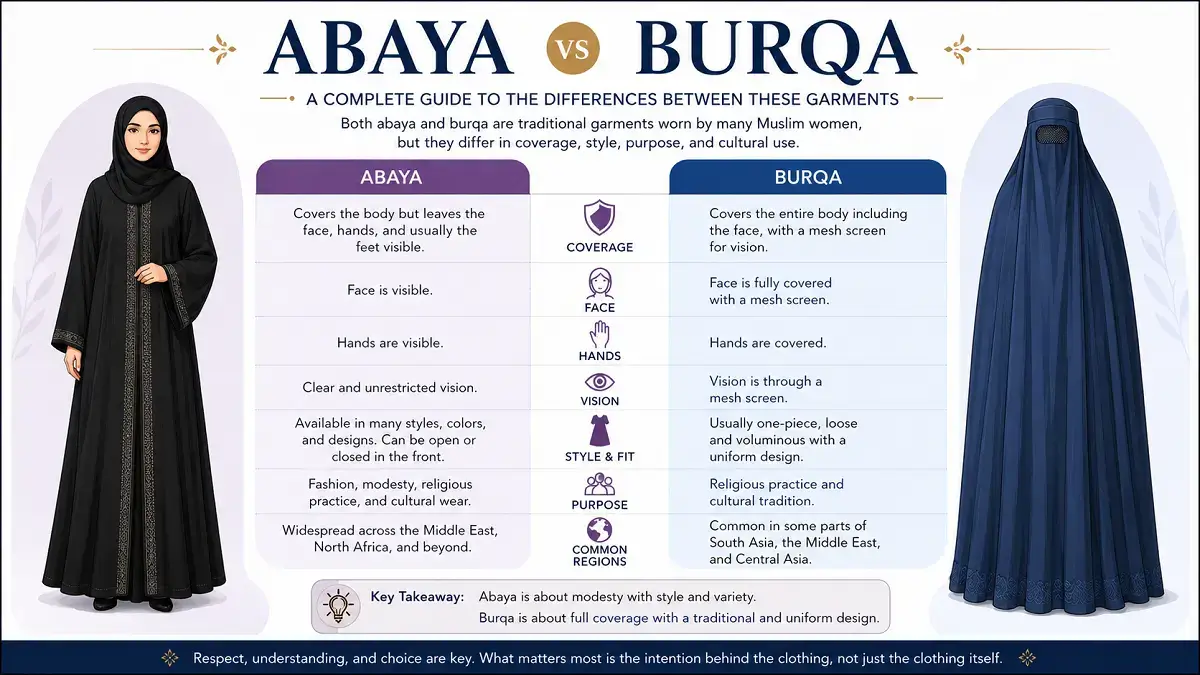
An abaya is a loose, full-length outer robe that covers the body while leaving the face and hands visible. A burqa covers the body and face together, usually with a mesh panel over the eyes for vision. The simple rule to remember: an abaya covers the body; a burqa covers the body and the face.
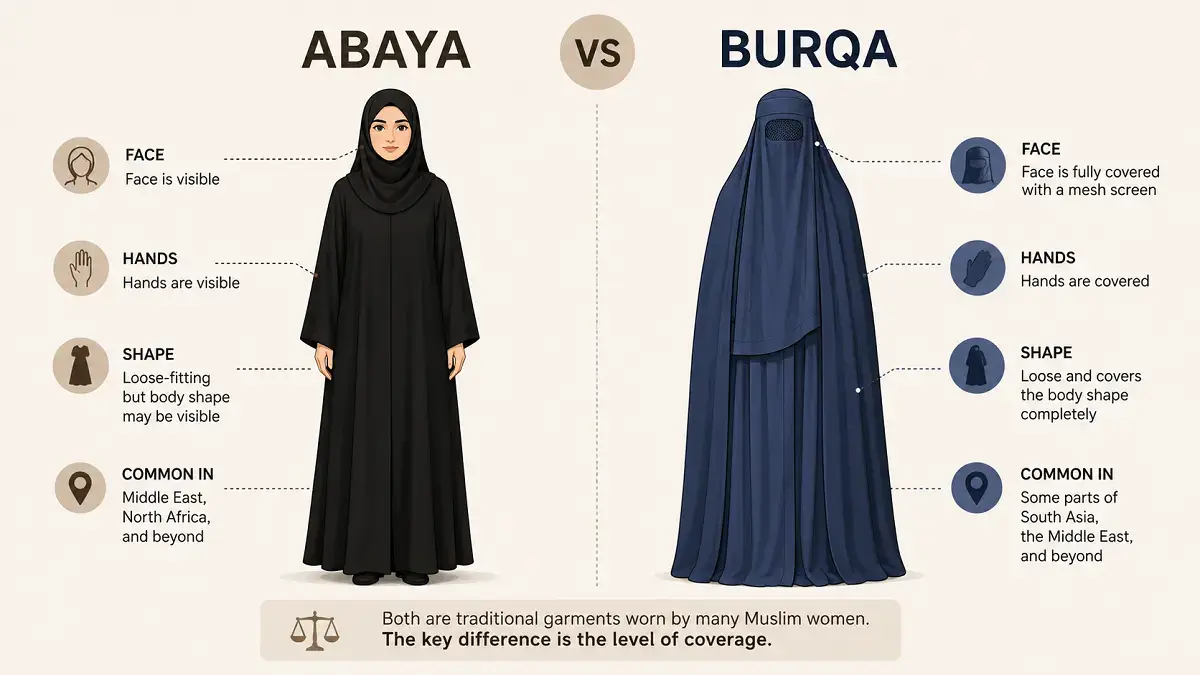
What Is an Abaya and a Burqa?
What Is an Abaya?
An abaya is a long, loose-fitting outer garment that drapes from the shoulders to the ankles. It’s typically worn over regular clothing as a modest outer layer, most commonly in the Arabian Peninsula Saudi Arabia, the UAE, Qatar and Kuwait among others though it’s now worn and sold worldwide. The word itself is Arabic and traditionally refers to any long, loose robe, worn by both men and women historically, though today it’s most associated with women’s modest fashion.
A classic abaya is black, made from lightweight fabric like nida or crepe and worn with a separate hijab (headscarf) to cover the hair. The face, hands and feet remain visible. That’s the key structural point: an abaya is an outer robe, not a face covering.
Modern abayas have moved well beyond the plain black robe. Designers now work with embroidery, laser-cut detailing, structured tailoring and a wide color palette, so the garment functions as both a religious/cultural practice and a fashion category in its own right.
What Is a Burqa?
A burqa is a full-body covering that goes a step further than an abaya: it conceals the face as well as the body. A traditional burqa combines a head covering, a body-length cape and a face veil with a mesh or net panel over the eyes, so the wearer can see while remaining fully covered. It’s most associated with Afghanistan and parts of Pakistan and South Asia, though styles and names vary a lot by region, a point covered in more detail below.
Because the burqa conceals the face, it represents the most complete form of covering within modest Islamic dress, distinct from garments like the hijab (hair and neck only) or the niqab (face covering worn as a separate piece over other clothing, rather than a single all-in-one garment).
It’s worth noting that neither the abaya nor the burqa is explicitly named in the Qur’an. Both developed as cultural and regional expressions of the broader Islamic principle of modest dress, which is why practice varies so much from country to country and even family to family.
Abaya vs Burqa: The Key Differences
Here’s a side-by-side look at how the two garments compare.
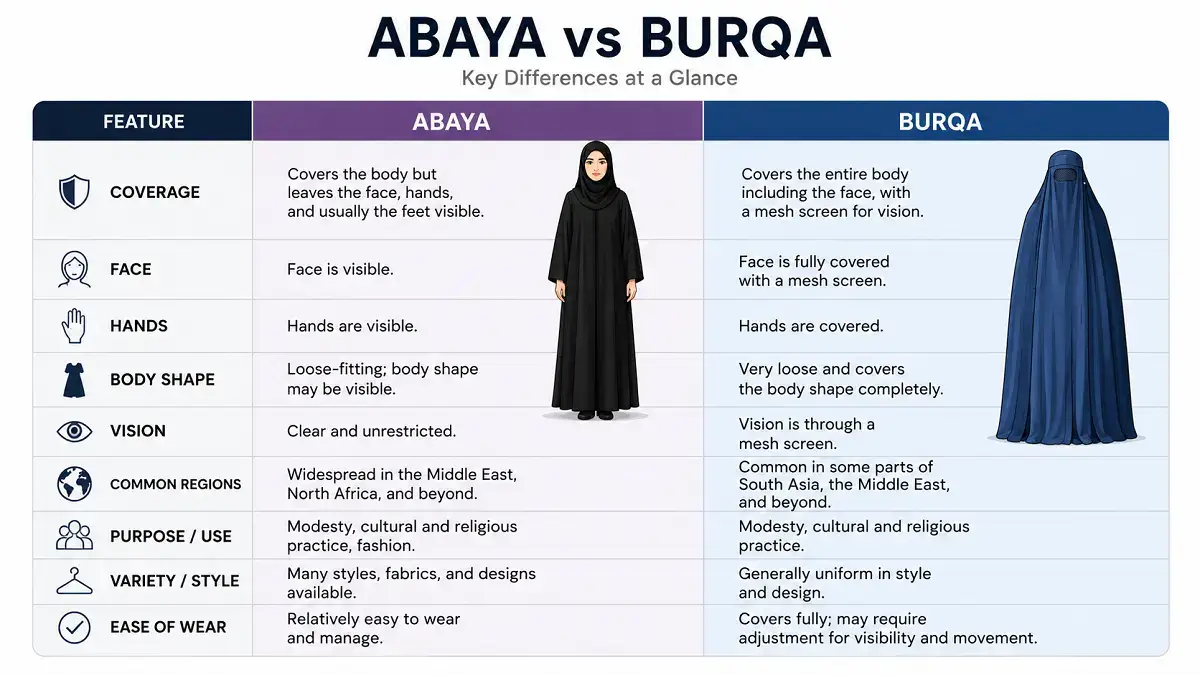
| Abaya | Burqa | |
|---|---|---|
| Coverage | Body, from shoulders to ankles | Body and face, head to toe |
| Face | Left visible | Covered, usually with a mesh eye panel |
| Structure | Single outer robe, worn over clothing | Combination of cap, body covering and face veil |
| Worn with | Often paired with a separate hijab | Self-contained; sometimes paired with a niqab instead of a built-in mesh |
| Most associated with | Arabian Peninsula, North Africa | Afghanistan, Pakistan, parts of South Asia and India |
| Common colors | Traditionally black; now available in many colors | Traditionally black, blue, white or green depending on region |
| Fashion evolution | Widely treated as a fashion category with seasonal trends | More conservative in styling; regional tradition dominates over fashion trends |
The core takeaway: coverage level is the real dividing line. An abaya is about covering the body modestly while keeping the face free. A burqa adds face concealment to that same principle. Everything else color, fabric, regional name, how it’s paired with other garments flows from that one structural difference.
Is an Abaya and a Burqa the Same Thing?
No. An abaya and a burqa are related but distinct garments. Both serve the same underlying purpose: modest dress but they achieve it differently. An abaya leaves the face uncovered; a burqa covers it. Because both are frequently grouped together on shopping sites and in casual conversation and because names for related garments (burqa, chador, niqab) overlap across regions, the two get treated as synonyms far more often than the design actually supports.
Types of Abaya and Burqa
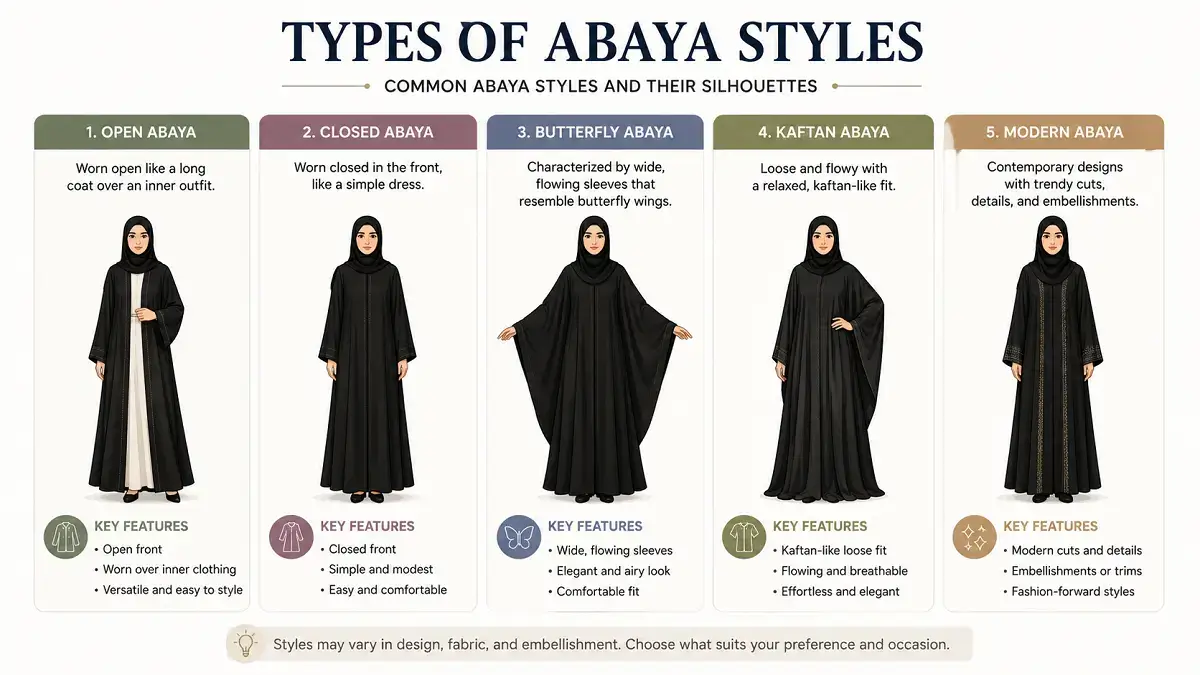
Common Abaya Styles
Abayas today come in a wide range of cuts and the differences are mostly about the sleeve shape, how the front closes and the overall silhouette:
- Open/front-open abaya opens down the front like a coat, worn over an inner dress; popular for both daily wear and formal occasions.
- Closed/overhead abaya a single pull-over piece with no front opening; often chosen for prayer and worship because it’s quick to put on.
- Butterfly abaya wide, flared sleeves that spread out dramatically when the arms are raised.
- Batwing abaya wide sleeves that taper at the wrist, giving a soft, draped look from shoulder to arm.
- Kimono abaya structured, relaxed sleeves inspired by Japanese robes.
- Kaftan abaya is a fluid, flowing silhouette often used for Ramadan and Eid occasions.
- Embroidered/embellished abaya a classic cut elevated with hand or machine embroidery, beadwork or lace detailing for formal events.
Regional Burqa Styles
Unlike the abaya, which is fairly consistent in shape, the burqa varies significantly by region to the point where different countries use different names for closely related garments.
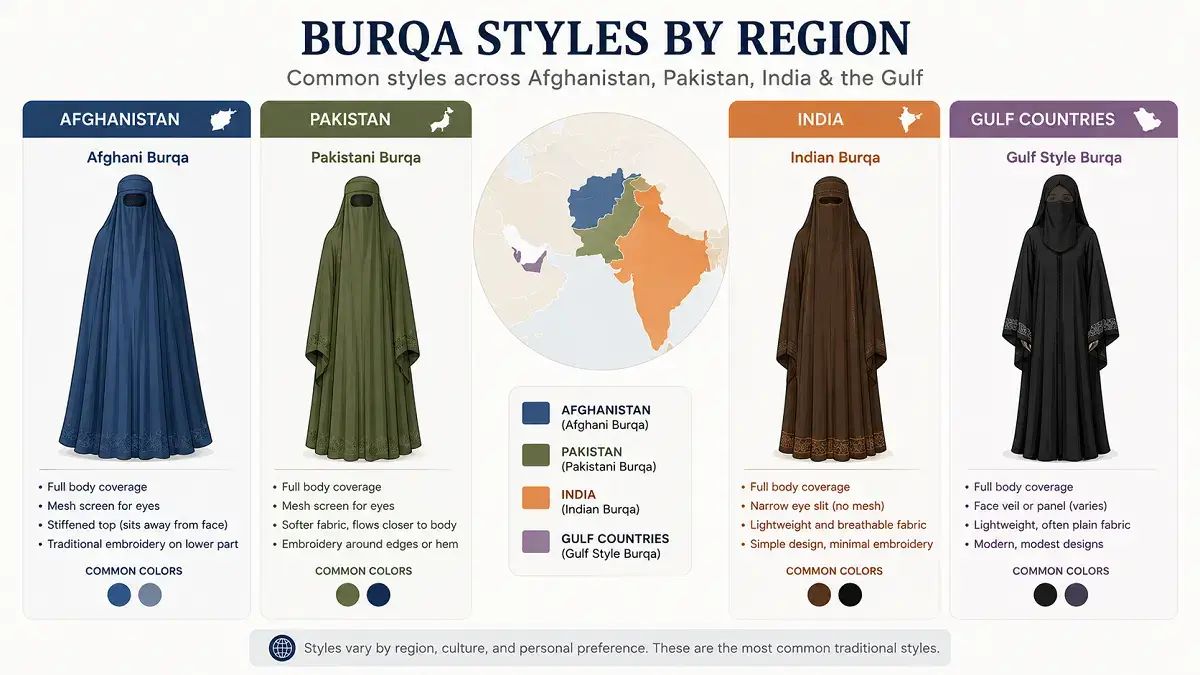
| Region | Common Name | Description |
|---|---|---|
| Afghanistan | Chadari / Chaderi | The most traditional style: a full-length garment with pleated fabric gathered from a fitted cap, plus a mesh eye panel. Colors vary by area light blue is common in the north; brown or green in the south. |
| Pakistan (Pashtun regions) | Burqa | Similar structure to the Afghan chadari but typically black and made from lighter material; a newer two-piece version pairs a large scarf with a separate face veil. |
| India | Burqa | Usually a slim, black, embroidered cloak, often paired with a separate niqab rather than a built-in mesh screen. Popular in cities such as Hyderabad, Old Delhi and Lucknow. |
| Gulf/Bedouin regions | Burqa with batula | In some Gulf communities, a face mask (batula) is worn instead of a mesh panel, alongside a separate body covering. |
A useful distinction: the Afghan chadari and the Pakistani/South Asian burqa are often treated as the same word in Western media but historically they’re related-but-separate garments the chadari is a single pleated piece built around a cap, while the South Asian burqa is typically assembled from a cap, cape and a separate face-veil panel.
Burqa, Hijab, Niqab, Abaya and Chador: How the Terms Relate
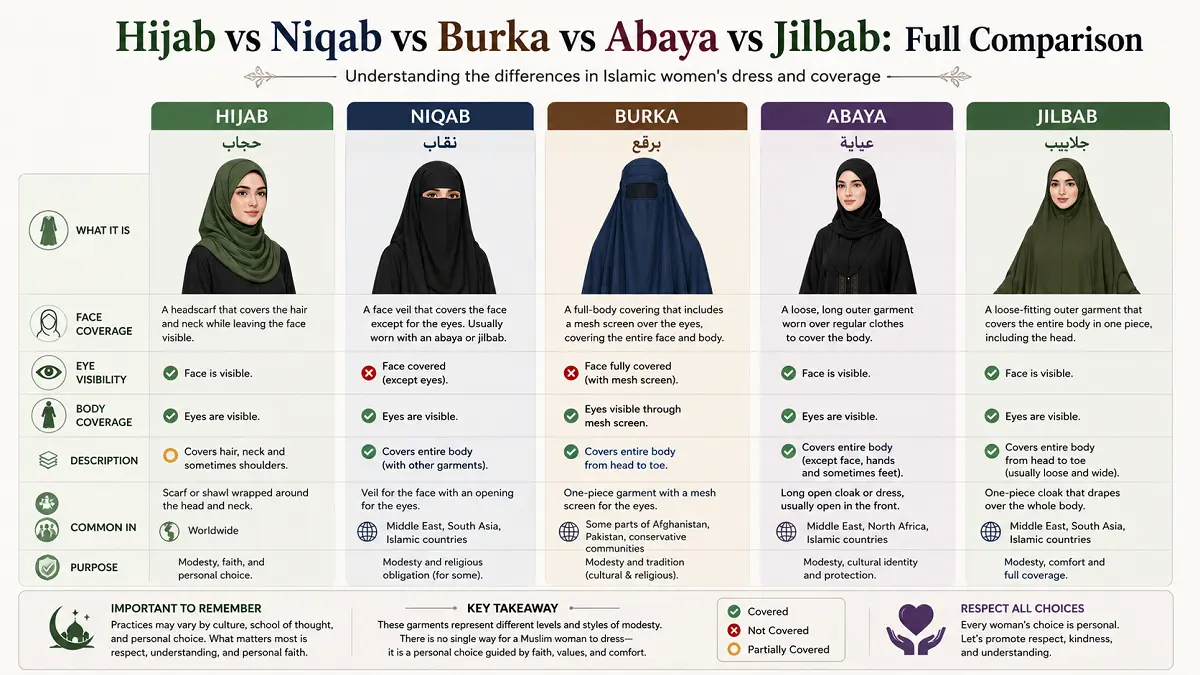
Because these words are so often confused, it helps to see them as a spectrum of coverage rather than five unrelated items.
Hijab vs Abaya vs Burqa
- Hijab a headscarf that covers the hair and neck, leaving the face fully visible. In Arabic, the word originally referred to a curtain or a separation and it’s the most widely worn and widely recognized of these garments.
- Abaya the outer robe covering the body, typically worn together with a hijab.
- Burqa the most complete covering, combining body and face concealment in one garment.
In short: a hijab covers the head, an abaya covers the body and a burqa covers both the body and the face. They aren’t competing terms for many women, hijab and abaya are worn together as two separate pieces, while a burqa is a single all-in-one alternative to that combination.
Niqab and Chador Explained
- Niqab is a face veil, usually worn with a separate abaya or coat and a headscarf, leaving the eyes visible. Unlike a burqa’s built-in mesh, the niqab is a distinct piece that can be added or removed independently.
- Chador a full-body cloak, open at the front and held closed by hand rather than fastened, most associated with Iran. It covers the hair and body but not necessarily the face, though it’s sometimes worn with a separate face veil for stricter coverage.
So when a burqa is described as combining a chador and a niqab, what’s meant is that it fuses the body-covering function of a chador-style cloak with the face-covering function of a niqab into a single garment.
Common Hindi and Urdu Terms
For readers searching in Hindi or Urdu, the same distinction holds: अबाया (abaya) refers to the body-covering outer robe, while बुर्का (burqa) refers to the full covering that includes the face veil. Regional usage varies in much of North India, burqa is used broadly to describe any full-body Islamic outer garment, including styles that would technically be classified as an abaya elsewhere, which is part of why the two terms get used interchangeably in everyday Hindi and Urdu conversation.
Abaya and Burqa Colors: Beyond Traditional Black
Black remains the most recognized color for both garments it reads as formal, modest and versatile, which is exactly why it became the default. But color choice has expanded considerably in recent years, especially for the abaya, which has evolved into a genuine fashion category.
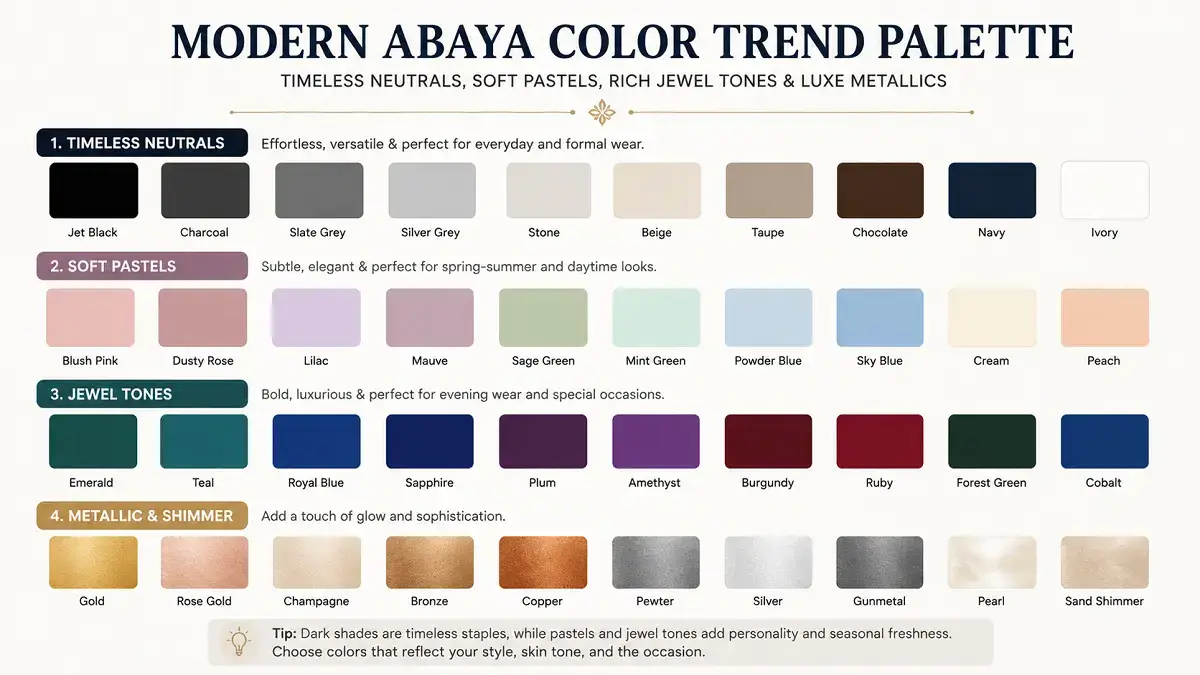
Current trends include:
- Earthy neutrals sand, taupe, olive and mocha tones that feel understated and pair easily with other pieces.
- Soft pastels blush pink, powder blue, lavender and mint green, often chosen for daytime or casual wear.
- Jewel tones emerald green, royal blue and deep burgundy, typically reserved for formal occasions and special events.
- Metallics and statement shades of gold, bronze and fuchsia detailing, usually used as accents (embroidery, trim or an occasion piece) rather than as an everyday color.
Burqas have followed a more conservative color path than abayas, largely because regional tradition plays a bigger role than fashion trends. Afghan chadaris are traditionally light blue, though white, green and brown variants exist by region; South Asian burqas are more commonly black. If you’re shopping for a colored piece, it’s more likely to be an abaya than a traditional burqa colored burqas exist but they’re the exception rather than the norm.
Modern Abaya and Burqa Designs
Modern abaya design has moved toward cleaner lines and better fabric performance rather than heavy ornamentation. Popular current directions include:
- Structured, minimal cuts clean silhouettes with the detail coming from drape and tailoring rather than embellishment.
- Technical and breathable fabrics lightweight crepe, linen blends and wrinkle-resistant materials suited to warmer climates.
- Textured fabric over heavy embroidery jacquard weaves, subtle sheen and mixed-fiber blends for a quiet luxury look.
- Color-blocking and tone-on-tone layering pairing two complementary shades within one outfit.
Burqa design has been more resistant to fast-changing trends, given its stronger tie to regional tradition and, in some places, to formal dress requirements. That said, lighter and more breathable fabrics have become more common and some newer two-piece styles (a large scarf paired with a separate face veil, for example) offer more flexibility than a single fitted garment.
Where to Buy: Wholesale Markets for Abaya and Burqa in India
India has several established hubs for sourcing abayas and burqas in bulk, each with a slightly different specialty.
| Location | Known For | Good to Know |
|---|---|---|
| Hyderabad Shahran Market (Old City, near Charminar) | Ready-to-wear burqas and hijabs, large-scale manufacturing | One of India’s most concentrated burqa and hijab wholesale hubs, with goods manufactured locally and exported both within India and abroad |
| Mumbai Bhendi Bazaar / Mohammed Ali Road area | Wholesale and retail abayas, burqas and hijabs | A historic Muslim quarter with a dense concentration of Islamic clothing traders |
| Surat, Gujarat | Abaya and burqa fabric (nida, crepe, chiffon, georgette) | Known as India’s textile hub better for sourcing fabric in bulk than finished garments |
| Delhi Chandni Chowk / Old Delhi area | Wholesale abaya and burqa traders, embroidered designs | Old Delhi is also known for its traditional embroidered burqa styles |
| Lucknow, Uttar Pradesh | Chikankari-embroidered abayas and burqas | Recognized for fine hand-embroidery craftsmanship |
Buying tips for wholesale sourcing:
- Request fabric samples before committing to a bulk order nida, crepe and georgette all drape and wear differently.
- Confirm minimum order quantities (MOQs) up front; they vary widely between suppliers, from a handful of pieces to 30+ per design.
- Check stitching and embroidery quality on a sample piece, not just photos.
- Verify supplier details independently, since prices and availability change often and aren’t reliable to quote without checking directly.
How to Choose Between an Abaya and a Burqa
There’s no single correct choice between the two the right option depends on a mix of personal, religious and practical factors:
- Personal and religious preference: Coverage level is a personal decision shaped by individual interpretation of modesty and it can vary even within the same family or community.
- Regional and family custom: In many communities, the norm is inherited by an abaya-and-hijab combination in the Gulf or a burqa in parts of South Asia and Afghanistan.
- Comfort and climate: A face-covering garment is warmer and can feel more restrictive in hot, humid conditions; an abaya alone is generally cooler and easier to move in.
- Occasion: Many women wear an abaya for daily life and reserve additional coverage, like a niqab, for specific settings or preferences.
- Local regulations: Some countries restrict full-face coverings in public spaces, so it’s worth checking local rules before traveling or relocating if a face-covering garment is part of your regular dress.
If you’re new to modest fashion and unsure where to start, an abaya paired with a hijab is the more common entry point, simply because it’s the more widely available and more fashion-flexible of the two.
Frequently Asked Questions
Conclusion
An abaya and burqa aren’t interchangeable words for the same outfit; they’re two distinct garments built around different levels of coverage. An abaya covers the body and leaves the face visible; a burqa covers the body and the face together, usually through a combined cap, cape and mesh-veil design. From there, the differences branch out by region, color, fabric and how each garment is paired with pieces like the hijab or niqab.
Whether you’re shopping for your first modest outerwear, sourcing stock from a wholesale market or simply wanting a clear answer to what’s the actual difference, the short version is worth remembering: coverage of the face is the line between the two. Everything else is regional style built on top of that one core distinction.